Celebrating Achievements and Sharing Research
06/23/2026 : Secure attachment as a buffer against childhood maltreatment
Childhood maltreatment is one of the strongest known risk factors for depression in adulthood. But not everyone who experiences early adversity carries the same relational scars forward. In our latest preprint, we looked at why: specifically, at adults who experienced maltreatment as children yet still went on to form secure attachments, a pattern we call interpersonal resilience.
Using structural MRI and behavioral data from 1,317 adults in the Marburg-Münster Affective Cohort Study (FOR2107 consortium), we compared four groups defined by attachment style (secure vs. insecure) and childhood maltreatment history (present vs. absent).
The behavioral picture was clear. Among people with a maltreatment history, those who were securely attached had meaningfully better mental health outcomes than those who were insecurely attached: lower self-reported and clinician-rated depressive symptoms, lower global symptom severity, and higher overall functioning. Attachment style mattered even more than maltreatment history itself when it came to explaining these differences.
The brain findings tell a related story. We identified a significant maltreatment-by-attachment interaction in the left supramarginal gyrus, a region involved in perspective taking and distinguishing our own emotional states from those of others. Adults who were securely attached despite a maltreatment history showed larger gray matter volume in this region than everyone else, including securely attached adults without maltreatment. This effect held up across a series of sensitivity analyses accounting for medication, diagnosis, and when we treated attachment and maltreatment as continuous rather than categorical variables.
Taken together, the results support secure attachment as a genuine protective factor after early adversity, not just at the level of symptoms and functioning, but in brain structure itself. That has real clinical implications: therapies that build trust, strengthen mentalizing, and support secure relational bonds may do more than improve how people feel. They may help shift the underlying trajectory after childhood adversity.
LINK: https://www.biorxiv.org/content/10.64898/2026.07.20.739488v1
- 08/25/25: SFN Trainee and Professional Development Award: I’m honored to receive a Trainee & Professional Development Award from the Society for Neuroscience (SfN). SfN is the world’s largest organization of scientists and clinicians dedicated to understanding the brain and nervous system, and its annual meeting is the premier venue for sharing cutting-edge neuroscience research.
This award supports my presentation at SfN 2025 in San Diego, where I’ll share our recent machine learning work showing how cortical thickness predicts socioeconomic adversity across development in the ABCD Study.
👉 You can read our preprint here: https://www.biorxiv.org/content/10.1101/2025.06.11.659188v1
- 06/16/25: New Commentary out: New commentary just published! We take a closer look at a recent study titled: “Having two children might be best for women’s mental health” and discuss methodological concerns with this paper. Read our commentary here: https://www.sciencedirect.com/science/article/pii/S0165032725011292?via%3Dihub
My co-authors and me are deeply committed to advancing women’s mental health in all its complexity. We believe it’s crucial to identify protective factors, but equally important to ensure that policy and clinical guidance is grounded in strong, transparent methods.
Women’s mental health is not one-size-fits-all. We hope this commentary helps encourage thoughtful discussion and continued research in this important area.
- Feeling super proud this research is now available as a preprint: 🚨 We used machine learning to examine how 7 types of early life adversity relate to cortical thickness in adolescents across 3 timepoints in the ABCD Study (baseline, N =6,908 ; 2-year,N=5,808 and 4-year follow-up, N=2,245).
🔎 We looked at: Physical & Sexual Abuse, Neighborhood Threat, Scarcity, Parental Psychopathology, Prenatal Substance Exposure, Household Dysfunction, and Socioeconomic Status (SES).
🧠 SES, Neighbhorhood threat and scarcity were sig. associated with cortical thickness. Despite weak correlations between these adversity measures, we found overlapping neural patterns, especially in regions linked to memory, visual processing, and higher-order cognition.
💡 This suggests a shared brain signature of broader environmental disadvantage, highlighting the importance of addressing inequality to promote neurodevelopmental health.
📄 Read the preprint here: https://www.biorxiv.org/content/10.1101/2025.06.11.659188v1
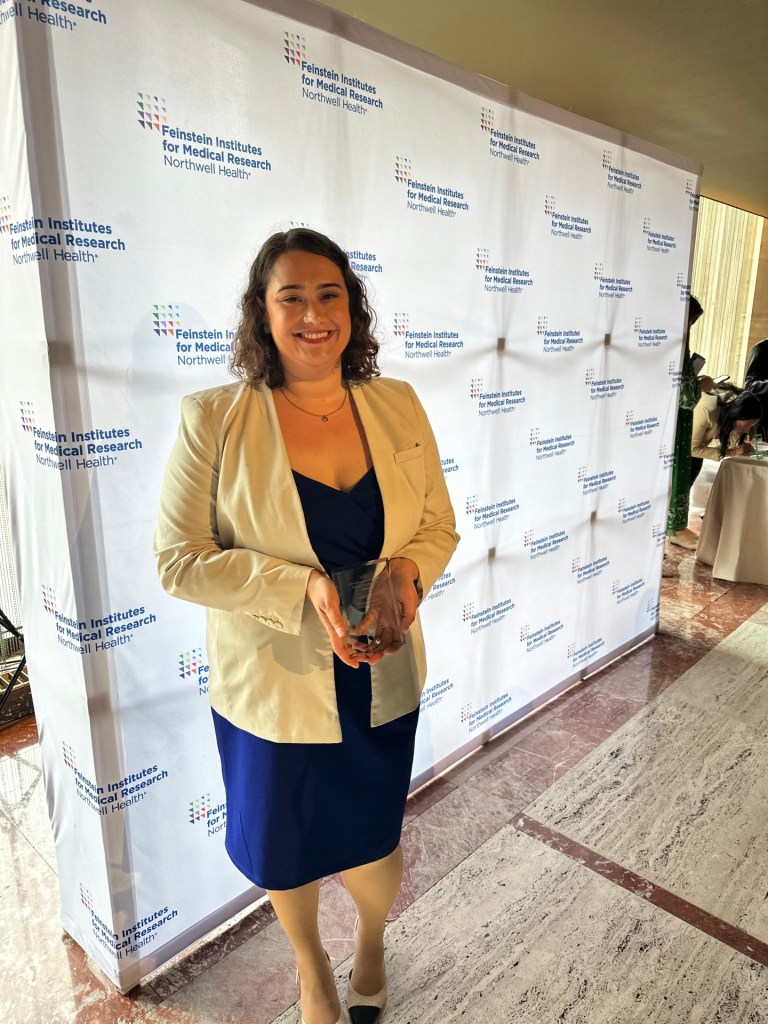
- May 2025: AWSM Award Recognition
“So proud to be part of the 2025 AWSM awardees across Northwell Health, recognized for our contributions to research and medicine. I feel incredibly lucky to be in a community that uplifts and champions women in science, and to share this moment with so many brilliant researchers!”
- February 2025: New Preprint on Childhood Sexual Abuse and Brain Development
“Excited to share our new preprint which examines unique effects of childhood sexual abuse on cortical thickness and gray matter volume. You can read the full article here: Preprint Link“ - February 2025: International Day of Women and Girls in Science at the UN
“My colleagues and I attended the International Day of Women and Girls in Science at the United Nations – an absolute privilege to represent The Feinstein Institutes and Northwell Health!”

- June 2024: Symposium at OHBM in Seoul, South Korea
“I chaired a symposium on risk and protective factors at OHBM in Seoul, South Korea. Very proud to facilitate a symposium on this important topic with international experts. Find my talk here on YouTube: Symposium Talk Link“ - May 2024: AWSM Educational Advancement Award
“I was awarded the Educational Advancement Award from AWSM in 2024! So happy to be chosen.”
 Dr Katharina Brosch